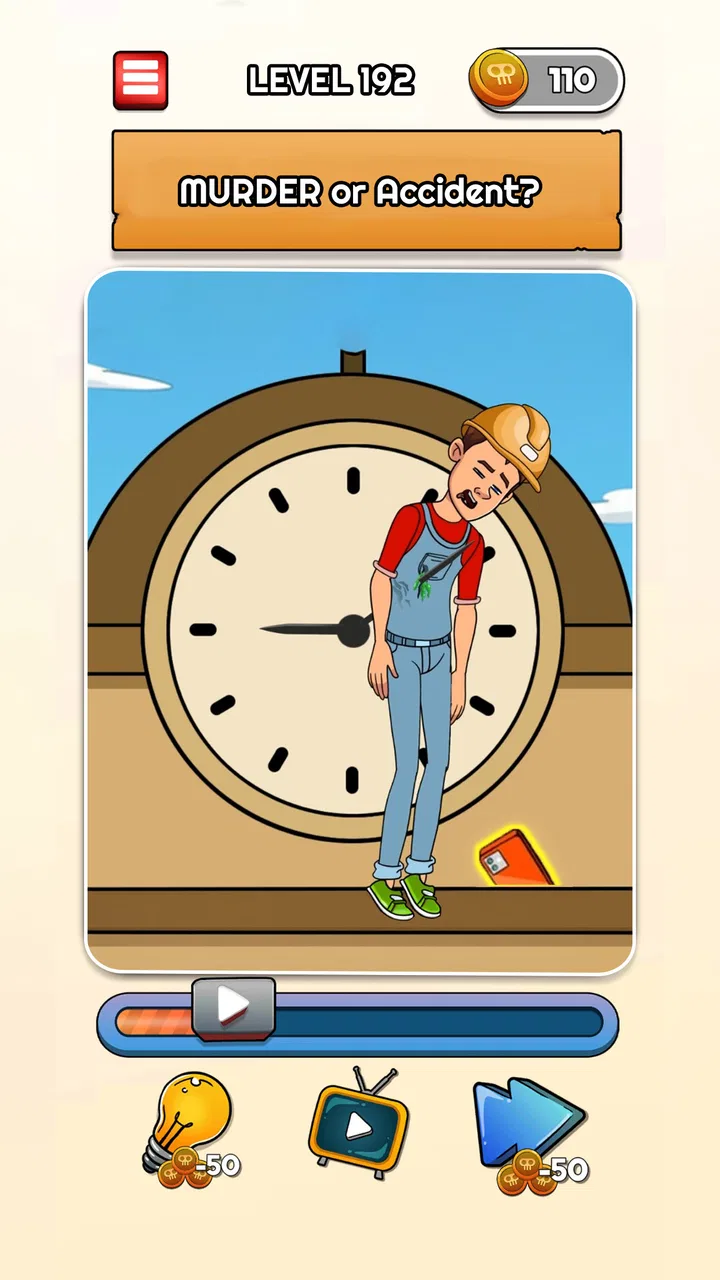
Flashback: Tricky Fun Riddles
- 4.8
- Rating
- 50.00M
- Installs
- Free
- Price

 Analysis by App-foxy
I enjoy puzzle games most when they give me a clear little challenge without demanding a full evening. Flashback: Tricky Fun Riddles fits that mood surprisingly well. It is a free puzzle game from Radiant Cat Studio built around visual thinking, quick observation, and the willingness to question the most obvious answer. The basic idea is easy to understand: examine what is on screen, slide or interact with elements, and work out the solution rather than simply tapping the first thing that looks important.
That simplicity is the reason I kept returning to it. The game does not need a complicated setup before a puzzle becomes interesting. I can open it when I have a few spare minutes, try to solve a riddle, and stop when something else needs my attention. At the same time, it is not just a collection of automatic answers. Some challenges deliberately encourage lateral thinking, so the satisfying moment often comes after I realize that I was following the wrong assumption.
Why the first few puzzles work so well
The strongest part of the experience is the immediate hook. Flashback presents itself as a mind game, but it does not bury the player under rules or a long tutorial. The interaction is based on looking carefully and trying sensible actions, which makes the opening feel approachable even if you are not usually a puzzle-game player.
You May Also Like

 Blood Strike: 2.5 Anniversary
Blood Strike’s Loadouts Turn Every Drop Into a Tactical Gamble
A close look at Blood Strike’s custom loadouts: how fast access to signature weapons reshapes its battle royale rhythm, rewards preparation, and narrows the gap between fights.

 Pandora - Music & Podcasts
Pandora’s Music Is Easy to Start, but Harder to Recover
Pandora’s strength is its low-effort path from a seed to a station. Its weak spot is how much confidence it asks you to place in connection, setup, and quiet recovery.

 8 Ball Pool
 Is Built on Rivalries, Rematches, and Routine
A close look at the rivalries, rematches, shared routines, and unanswered safety questions that turn a quick pool match into a persistent mobile community.

 Samsung Music
’s Quiet Strength Is Playing What You Already Own
Its reach comes less from spectacle than from dependable access to a personal library. That simplicity is both the app’s strongest retention engine and its ceiling.

 AccuWeather: Weather Radar
AccuWeather Review: A Quick, Clear Forecast for Everyday Decisions
For everyday plans, the best forecast is the one you can understand quickly. AccuWeather makes rain timing, radar, and local conditions easy to act on, with a few trade-offs.

 Hill Climb Racing
Why Hill Climb Racing Still Turns Crashes Into One More Run
A tiny car, a bumpy hill and one more upgrade: Hill Climb Racing keeps resurfacing because its simple chaos makes every near-miss feel personal.
More From Our News Desk



I found the best results came from treating each screen like a small investigation. Instead of tapping everywhere in frustration, I first looked for anything that seemed movable, unusual, or slightly out of place. The title’s focus on sliding is important because the intended answer may depend on changing the arrangement rather than selecting the obvious object. That small shift in attitude turns a simple screen into a visual riddle.
The game’s average rating of 4.8, supported by around 522 thousand ratings, suggests that this accessible format has connected with a large audience. Its reach is also substantial, with over 10 million installs. Those figures do not guarantee that every puzzle will suit every player, but they do reflect how easily the concept can be picked up by people looking for a lightweight brain game rather than a demanding strategy title.
What I appreciate is that the challenge usually begins before I touch the screen. I have to decide what deserves attention, whether an apparent clue is a distraction, and whether the scene should be read literally. That makes the first successful solution feel more personal than simply matching colors or following a fixed pattern.
A useful way to read each screen
My most reliable approach is to separate observation from action. I look at the whole scene first, then test one idea at a time. If I immediately start swiping randomly, I lose track of what changed and why. If I pause for a moment and identify the likely movable elements, the puzzle becomes less noisy and the eventual solution is easier to understand.
Another helpful habit is to question the obvious object. In many casual riddles, the largest item appears to be the answer because it attracts attention. Here, the less prominent detail may matter more. I also check whether the screen’s arrangement is hiding something instead of assuming that every clue is already visible. This is not a formal walkthrough, but it is a practical method that reduces wasted taps.
That approach gives the game a gentle learning curve without making it feel like a lesson. I gradually became better at recognizing when a puzzle wanted a swipe, when it wanted a closer look, and when my first interpretation was too literal. The game is at its most enjoyable when it teaches that habit through discovery rather than explaining it with long instructions.
Short sessions, interruptions, and returning later
Flashback is particularly comfortable in the gaps of an ordinary day. I can play while waiting for an appointment, during a short break, or when I want something more active than scrolling. A single riddle can provide a complete moment of entertainment, so I do not feel forced to reserve a large block of time for it.
This matters because many puzzle games create pressure through long stages, complicated boards, or progress systems that are difficult to remember after an interruption. Flashback’s riddle-based format feels easier to put down. If I close the game after getting stuck, I can return later with a fresh perspective instead of having to reconstruct a lengthy strategy.
That pause-and-return quality is one of its practical strengths. A puzzle that seemed impossible after several attempts may become obvious when I see it again later. For me, the break is not just convenient; it is part of the solving process. The game benefits from a player who is willing to stop before frustration turns into random tapping.
It also works well as a shared casual game. I can hand the phone to another person and ask what they notice without needing to explain a complicated control scheme. One person may focus on the visual arrangement while another thinks about the wording or the intended trick. That makes the riddles suitable for a quiet moment with a friend or family member, although the Teen content rating means I would not automatically treat it as a game for very young children.
The Teen rating is worth considering before downloading. This is still a puzzle title rather than an action game, but the age classification should guide parents who are choosing something specifically for younger players. For adults and older teens who want visual riddles, the rating is unlikely to change the basic appeal, but it is sensible to check the store presentation yourself before handing it to a child.
What happens when I get stuck
The main friction is that lateral-thinking puzzles can feel unfair when the intended interpretation is too far from the player’s expectations. There are moments when I understand the trick only after seeing the answer, and that can reduce the satisfaction. A good riddle makes me think, while a vague one can make me wonder whether I missed a clue or simply guessed the developer’s preferred action.
My advice is to avoid repeating the same gesture more than a few times. If a swipe in one direction changes nothing, try examining the relationship between objects instead of testing every possible movement. I also find it useful to take a short break rather than immediately searching for help. The game’s short-session design makes that easy, and returning with a clear mind often works better than forcing the solution.
Players who want a completely transparent logic system may find this style less comfortable than number puzzles, word grids, or traditional match games. Those alternatives usually make the rules visible and let you improve through a consistent method. Flashback is more playful and visual, but its answers can depend on noticing the intended trick. That trade-off is central to whether you will enjoy it.
How the rhythm holds up over repeated play
The game’s replay value comes less from replaying an individual riddle and more from the variety of ways it asks me to look at a screen. The pleasure is in encountering a new visual setup and discovering what kind of thinking it requires. When the trick feels fair, I get a quick burst of satisfaction and move on to the next challenge.
However, the same structure can become repetitive if I play for too long in one sitting. The basic loop remains familiar: inspect the scene, try an interaction, rethink the clue, and solve the riddle. That loop is excellent for short sessions, but it does not have the depth of a large strategy game or the endless procedural variety of some arcade puzzles. I prefer treating it as a snack-sized game rather than expecting a marathon experience.
This is where the editorial angle matters most: Flashback is strongest when I judge it by immediate pleasure rather than by the size of its long-term system. It gives me a compact problem, a moment of confusion, and a rewarding click when the solution makes sense. If I demand constant novelty for hours, the format is less convincing. If I want a few clever distractions throughout the day, it performs much better.
The free entry also lowers the risk of trying it. The game is listed as free, while optional in-app purchases range from $0.99 to $7.99 per item. I would keep that in mind if I were installing it on a device used by a child or sharing a payment method. For my own use, the important point is that I can judge the core style before deciding whether any optional purchase is worthwhile.
There is also a practical device consideration. The current version is 1.9.4 and requires Android 8.1 or later. That makes it a realistic choice for many reasonably recent Android phones, but anyone using an older handset should check compatibility before planning around it. I would not choose an app that requires a newer operating system for a spare device without checking first.
Three small habits that improve the experience
First, I solve with my eyes before solving with my fingers. A quick scan of the entire screen often reveals a relationship that is easy to miss when I focus only on the central object. This is especially useful in a game where sliding and rearranging can matter more than tapping.
Second, I use failed attempts as information. If an action produces no visible result, I do not treat it as wasted time; I ask what that tells me about the puzzle. Maybe the target is not interactive, maybe the direction is wrong, or maybe I have misunderstood which element is relevant. This turns trial and error into a controlled process.
Third, I stop at the point where concentration turns into irritation. Because the game is built for brief sessions, there is little benefit in grinding through a riddle while annoyed. I have had better results by closing it, doing something else, and returning later. That is a genuine strength compared with puzzle games that punish a break by making me lose a long chain of progress.
A fourth habit is useful when playing with someone else: explain your theory before making the next move. Saying, “I think the arrangement is hiding the clue,” is more productive than passing the phone back and forth while both players tap randomly. It also makes the game feel more social without requiring a multiplayer mode or a competitive scoreboard.
Who should play it, and who should choose something else
I would recommend Flashback to someone who likes visual riddles, quick brain teasers, and games that can be opened without preparation. It is a good fit for commuters, casual players, and anyone who enjoys the small satisfaction of spotting an unexpected solution. It also suits people who do not want to memorize complex rules before they can have fun.
It is less suitable for players who need every answer to follow strict, teachable logic. If you prefer Sudoku-style deduction, word puzzles with clearly defined clues, or match games with predictable progression, Flashback may sometimes feel too dependent on interpretation. Those alternatives are better when you want to measure improvement through a stable system rather than through visual surprise.
I would also skip it if my main goal were a deep long-term challenge. The game can keep me entertained across multiple short visits, but its appeal is concentrated in individual riddles and the freshness of their tricks. It is not the kind of title I would replace a large adventure, a serious strategy game, or a competitive puzzle platform with.
On the other hand, its lack of heavy commitment is exactly why I keep it available. I do not need to remember a complicated campaign or prepare a quiet hour. I can play one puzzle while coffee is brewing, pause when the day gets busy, and return when I want another small challenge. That everyday flexibility is more valuable to me than a large collection of systems I may never use.
Radiant Cat Studio has chosen a focused concept rather than an overloaded one, and that focus gives the game its identity. The experience is about noticing, sliding, reconsidering, and enjoying the instant when a strange-looking setup suddenly makes sense. It is not perfect, especially when a riddle’s intended trick feels under-explained, but the short format keeps those frustrations manageable.
For readers wondering whether it is worth trying, my answer is yes if you want a free, low-commitment puzzle game with a playful visual style. I would install it on a compatible Android device, test several riddles, and pay attention to how I react when the answer is not obvious. If the uncertainty feels amusing, it may become a reliable break-time game. If it feels arbitrary, a more rule-driven puzzle app will probably be a better match.
My casual verdict is that Flashback: Tricky Fun Riddles succeeds because it understands the value of a small, complete challenge. It gives me something to think about immediately, tolerates interruptions naturally, and rewards a fresh look after I step away. The repetition is noticeable during long sessions, and the occasional unclear trick can test my patience, but those weaknesses are easier to accept when I play it in the way it suits best: one clever riddle at a time.
FAQs for Flashback: Tricky Fun Riddles
01What is Flashback: Tricky Fun Riddles?
Flashback: Tricky Fun Riddles is a puzzle game designed to challenge your problem-solving skills with clever and unexpected riddles. Each level presents a unique scenario requiring creative thinking to solve. It's perfect for those who enjoy brain teasers and want to test their logical reasoning abilities in a fun and engaging way.
02Is Flashback: Tricky Fun Riddles free to play?
Yes, Flashback: Tricky Fun Riddles is free to download and play. However, like many mobile games, it offers in-app purchases. These can enhance the gaming experience by providing hints or unlocking additional levels. Players can enjoy the game without spending money, but these options are available for those who want them.
03How difficult are the riddles in Flashback: Tricky Fun Riddles?
The difficulty of the riddles in Flashback varies greatly, offering something for everyone from beginners to seasoned puzzle enthusiasts. Early levels are designed to be relatively simple, introducing players to the game's mechanics. As players progress, the riddles become more complex and require more lateral thinking to solve.
04What platforms is Flashback: Tricky Fun Riddles available on?
Flashback: Tricky Fun Riddles is available for both Android and iOS devices. You can download it from the Google Play Store for Android users and the Apple App Store for iOS users. The game is optimized to run smoothly on most smartphones and tablets, providing a seamless gaming experience.
05Does Flashback: Tricky Fun Riddles require an internet connection?
Flashback: Tricky Fun Riddles can be played offline, making it an excellent choice for gaming on the go without worrying about data usage. However, some features, such as in-app purchases and updates, require an internet connection. It's recommended to connect occasionally for the best experience.
Pros
- Engaging puzzles that stimulate critical thinking.
- Unique art style enhances visual appeal.
- Regular updates with new riddles and challenges.
- User-friendly interface simplifies navigation.
- Encourages social play with friend challenges.
Cons
- Some levels can be overly difficult.
- Ads can interrupt gameplay.
- Limited hints available per day.
- Requires internet for some features.
- Occasional minor bugs affect performance.

Flashback: Tricky Fun Riddles
Gallery